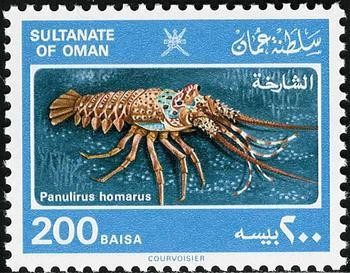
Scalloped Spiny Lobster (Panulirus homarus)
The Scalloped Spiny Lobster (Panulirus homarus), locally known in Arabic as Sharon (شارخة), is a benthic decapod crustacean in the family Palinuridae. Widely distributed across the Indo-West Pacific, its range spans from East Africa and the Arabian Peninsula to Southeast Asia and Japan. The species typically reaches a length of 20 to 25 cm (about 8 to 10 inches). Lacking the heavy crushing claws of clawed lobsters, it features long, multi-articulated, whip-like antennae, a spiny carapace, and distinct transverse grooved scutes ("scallops") across its abdominal segments. In the waters surrounding southern Arabia and Oman, the species is represented by a distinct reddish-brown subspecies, Panulirus homarus megasculpta.
Ecologically, Panulirus homarus is a nocturnal, gregarious inhabitant of shallow coastal waters, rocky reefs, and wave-swept surf zones at depths usually between 1 and 15 meters. During the day, individuals shelter in crevices and under coral ledges, emerging at night to forage primarily on bivalves like brown mussels (Perna perna), barnacles, and small benthic invertebrates. Beyond its biological role, the Scalloped Spiny Lobster holds major economic importance along Oman’s southern coastlines (particularly Dhofar and Al Wusta), where it supports one of the nation's most valuable artisanal commercial fisheries. To prevent overexploitation, Oman implemented strict seasonal harvesting windows and minimum size regulations, making the species a key focus of national marine management and sustainable resource conservation.
Ecologically, Panulirus homarus is a nocturnal, gregarious inhabitant of shallow coastal waters, rocky reefs, and wave-swept surf zones at depths usually between 1 and 15 meters. During the day, individuals shelter in crevices and under coral ledges, emerging at night to forage primarily on bivalves like brown mussels (Perna perna), barnacles, and small benthic invertebrates. Beyond its biological role, the Scalloped Spiny Lobster holds major economic importance along Oman’s southern coastlines (particularly Dhofar and Al Wusta), where it supports one of the nation's most valuable artisanal commercial fisheries. To prevent overexploitation, Oman implemented strict seasonal harvesting windows and minimum size regulations, making the species a key focus of national marine management and sustainable resource conservation.