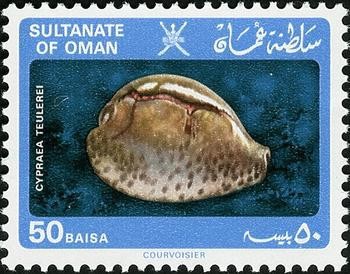
Teulere's Cowry (Cypraea teulerei)
Barycypraea teulerei (historically classified as Cypraea teulerei and commonly known as Teulere's Cowry) is an extraordinary and highly localized marine gastropod mollusk belonging to the family Cypraeidae. This unique sea snail is endemic to the northwestern Indian Ocean, with its primary habitat concentrated along the intertidal mudflats, shallow rocky reefs, and sandy bays of the Sultanate of Oman, particularly around the remote waters of Masirah Island. Unlike most typical cowries, which exhibit high-gloss finishes and standard ovate profiles, Teulere's Cowry is famously prized by malacologists and shell collectors for its distinct, satin-like matte luster and a somewhat distorted, inflated shape with heavy, calloused margins. Its dorsal surface typically displays a mottled pattern of olive-green, cream, and dark brown markings, completely lacking the terminal spots seen in other related species.
Because of its status as an iconic and globally renowned treasure of the region's marine ecosystems, this striking gastropod was selected by Omani postal authorities to represent the marine fauna selection of the acclaimed 1982 Flora and Fauna Definitive Series. Flawlessly produced via photogravure by the Swiss security printing firm Courvoisier, the stamp features a detailed, scientifically accurate illustration showcasing the shell's distinctive profile, unique coloration, and robust form against a clean background. Symmetrically balanced with the country name in both English and elegant Arabic script alongside the national emblem of crossed swords and a khanjar, this philatelic issue allowed the Omani administrative framework to formally catalog, preserve, and project its rich coastal biodiversity onto the global stage during a period of rapid national development.
Because of its status as an iconic and globally renowned treasure of the region's marine ecosystems, this striking gastropod was selected by Omani postal authorities to represent the marine fauna selection of the acclaimed 1982 Flora and Fauna Definitive Series. Flawlessly produced via photogravure by the Swiss security printing firm Courvoisier, the stamp features a detailed, scientifically accurate illustration showcasing the shell's distinctive profile, unique coloration, and robust form against a clean background. Symmetrically balanced with the country name in both English and elegant Arabic script alongside the national emblem of crossed swords and a khanjar, this philatelic issue allowed the Omani administrative framework to formally catalog, preserve, and project its rich coastal biodiversity onto the global stage during a period of rapid national development.